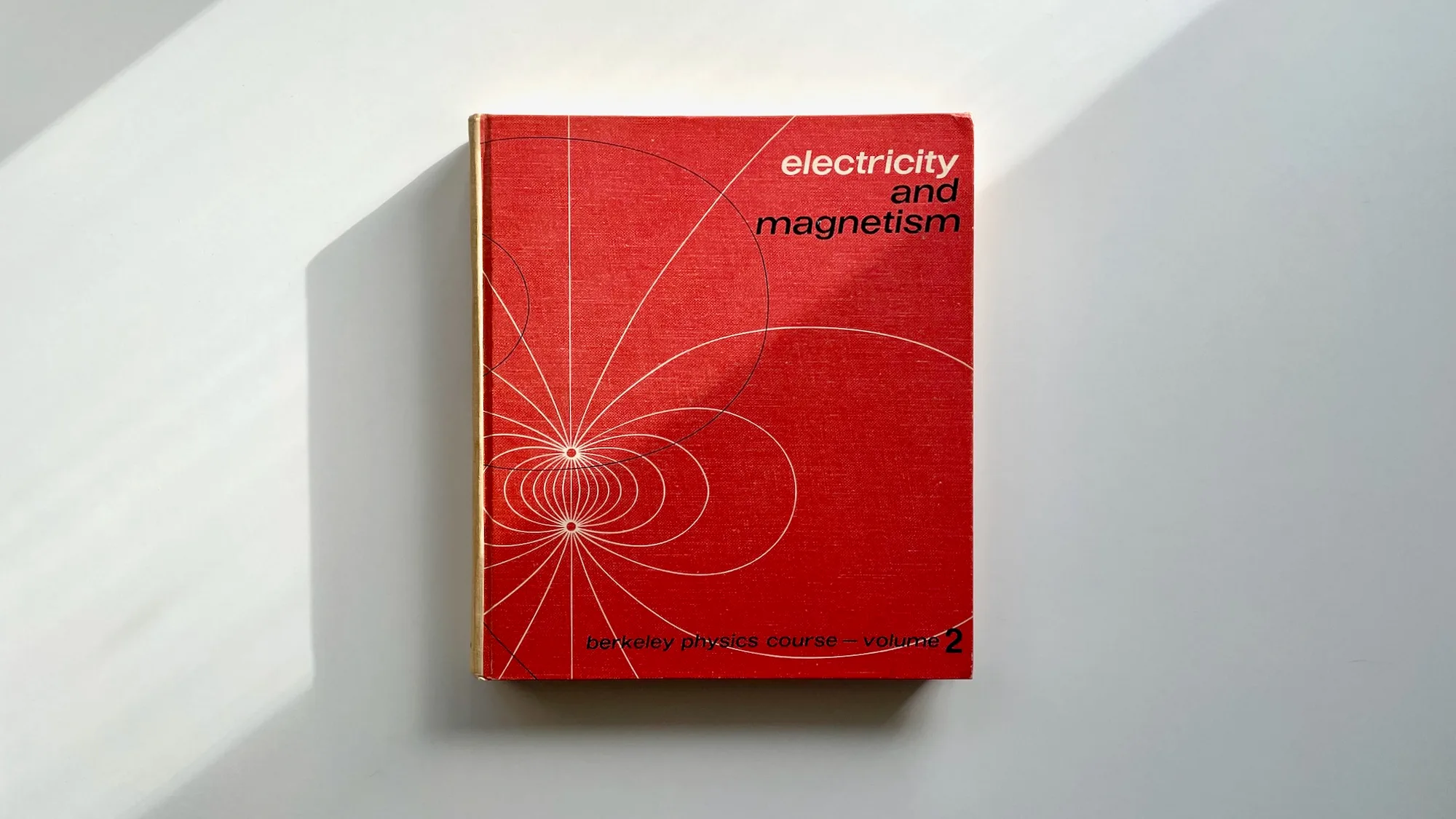
Received Purcell's Electricity and Magnetism. Much like The Feynman Lectures, this book is a product of the Sputnik era when textbooks were still written for serious students. This first edition published by McGraw-Hill (ISBN: 9780070048591) is lean and tight and simply well made; the latest version from Cambridge University Press feels a bit bloated by comparison.

There's something magical about the fact that you can buy access to such knowledge for the price of a meal.

Jan 25, 2026 #physics

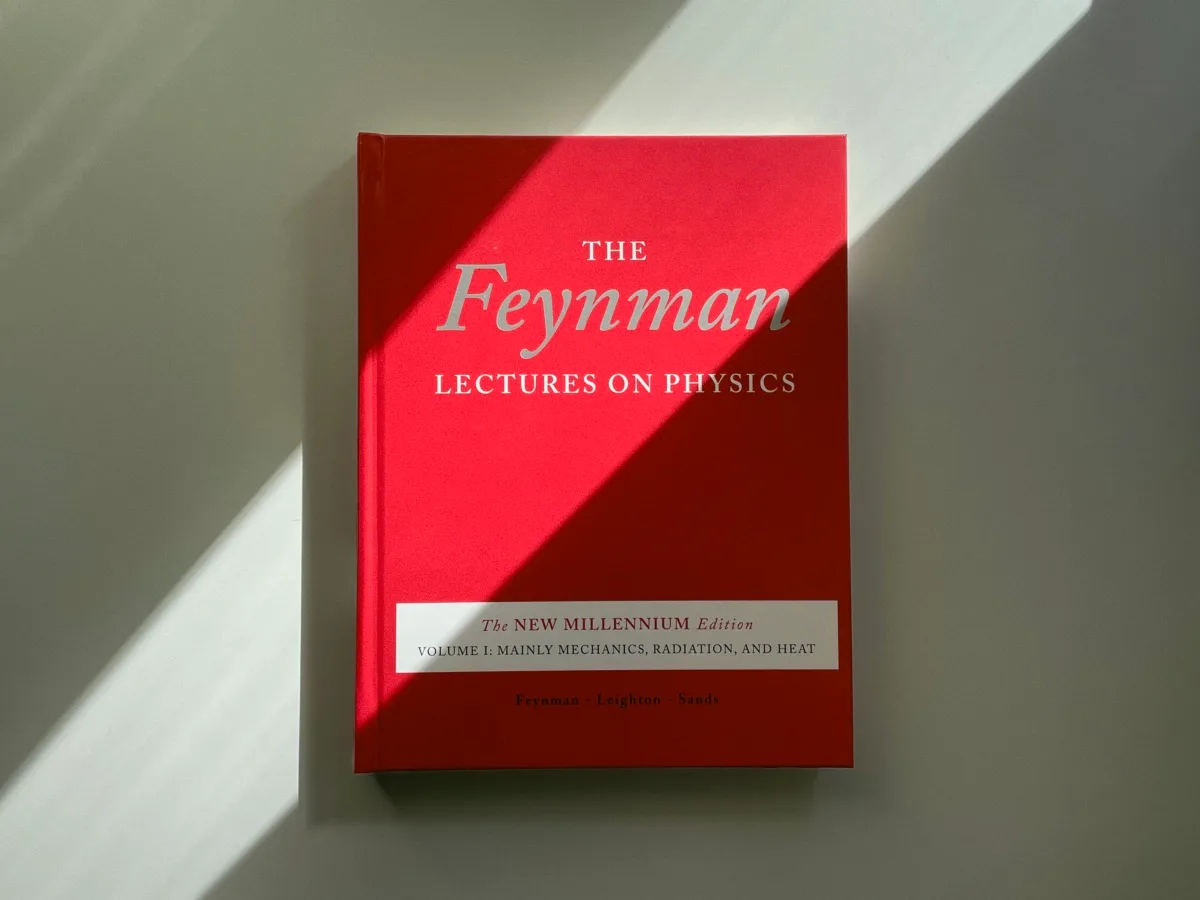
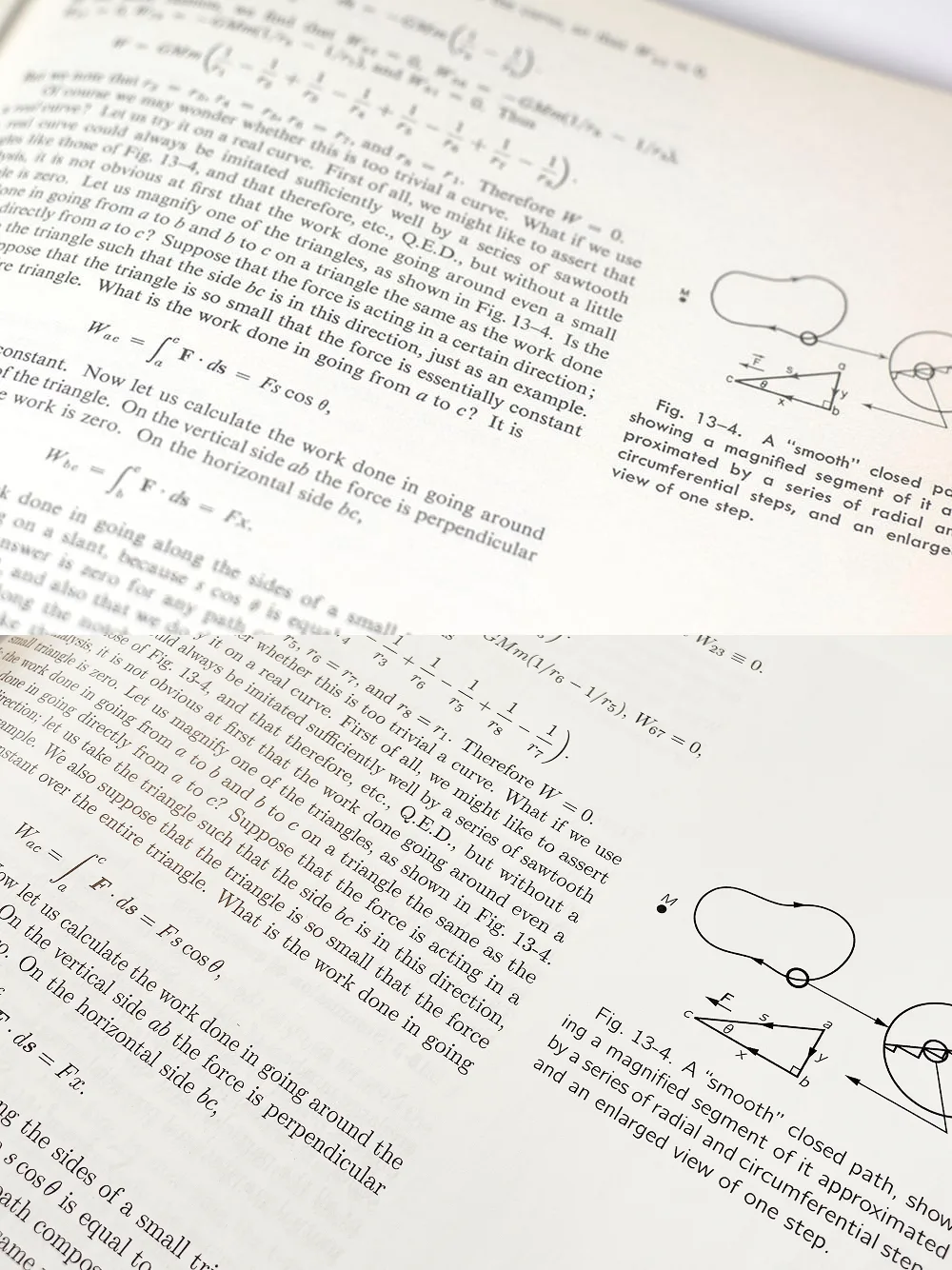
I found a photo from the previous edition of The Feynman Lectures on Physics published by Pearson/Addison-Wesley. It looks better than the New Millennium Edition from Basic Books that I have. I love Verdana, but the move from Futura to Verdana is sad. Futura feels very "Space Age" and academic. Verdana feels "odd" and digitally generic. The figures also look warmer when they aren't as sharp as they are in the newer edition. The pages were thicker, too; the new edition’s pages are so thin that you can see the text from the next page.

The only, but very big reason to choose the newest edition is the huge number of errors they fixed.

Jan 13, 2026 #physics

I bought two new math textbooks: George F. Simmons’s Calculus with Analytical Geometry and his Differential Equations with Applications and Historical Notes. I’ve only started the calculus book, but I already love it. It complements Spivak’s austerity and rigor very well with a more practical approach.

Dec 23, 2025 #physics

It’s been almost a year since I started going through the Feynman Lectures. After this year, I can tell what worked well and what work not so well.

I really enjoy the style. I like that Feynman doesn’t treat me as an idiot. He doesn’t try to follow a certain path and openly discusses ideas that are usually left for more advanced courses. I like that this book aims at intuition and true understanding, and not just mechanically remembering and applying formulas. I like how he sometimes gives you a perspective that connects things in a way that you’re left speechless.

I like the book itself. It’s classic and elegant. I don’t know why everything should be playful, colorful, and flashy. The Feynman lectures feel timeless.

I went through fourteen lectures so far, which is not a lot, and it makes me sad. I was also going through Spivak’s Calculus at the same time and covered half the book. The reason why I covered so few lectures is that, for some reason, I stopped reading and doing exercises at the end of March, and I never picked up the momentum until very recently. So I wasted almost half a year.

Consistency is more important than inspiration because consistency builds momentum. It’s challenging to get back on track once you stopped.

Doing exercises helps a lot. Often, I found myself thinking, “Oh, that’s easy, I understand that,” only to later discover that I have no idea how to approach a problem. Theoretical and practical knowledge are different things. It’s also easy to confuse understanding with familiarity.

Space repetition works. Even though I wasn’t reading the lectures for half a year, I still kept doing Mochi cards from time to time. It’s probably the only thing that helped me to keep my knowledge from the previous months.
Oct 02, 2025 #physics

Feynman’s Lectures Exercises 8.2 via the Center-of-Mass Frame

First, calculate the velocity of the CM frame:

vcm=mv+m⋅0m+m=v2\mathbf{v}_{\text{cm}} = \frac{m \mathbf{v} + m \cdot 0}{ m + m } = \frac{\mathbf{v}}{2}

Now, calculate velocities of particles in the CM frame:

v1cm=v−vcm=v2\mathbf{v}_1^{\text{cm}} = \mathbf{v} - \mathbf{v}_{\text{cm}} = \frac{\mathbf{v}}{2} v2cm=0−vcm=−v2\mathbf{v}_2^{\text{cm}} = 0 - \mathbf{v}_{\text{cm}} = -\frac{\mathbf{v}}{2}

In the CM frame, particles will have the same speeds after elastic collision, meaning:

∣u1∣=∣u2∣=∣u∣=v2|\mathbf{u}_1| = |\mathbf{u}_2| = |\mathbf{u}| = \frac{v}{2}

The directions of these velocities will be opposite, that is:

u1=uu2=−u\begin{aligned} \mathbf{u}_1 &= \mathbf{u} \\ \mathbf{u}_2 &= -\mathbf{u} \end{aligned}

Now, let’s move back to the lab frame:

v1=u+v2v2=−u+v2\begin{aligned} \mathbf{v}_1 &= \mathbf{u} + \frac{\mathbf{v}}{2} \\ \mathbf{v}_2 &= -\mathbf{u} + \frac{\mathbf{v}}{2} \end{aligned}

Let’s calculate the dot product:

v1⋅v2=(u+v2)⋅(−u+v2)=−∣u∣2+u⋅v2−u⋅v2+v2⋅v2=−(v2)2+(v2)2=0\begin{aligned} \mathbf{v}_1 \cdot \mathbf{v}_2 &= \left( \mathbf{u} + \frac{\mathbf{v}}{2} \right) \cdot \left( -\mathbf{u} + \frac{\mathbf{v}}{2} \right) \\[10pt] &= -|\mathbf{u}|^2 + \mathbf{u} \cdot \frac{\mathbf{v}}{2} - \mathbf{u} \cdot \frac{\mathbf{v}}{2} + \frac{\mathbf{v}}{2} \cdot \frac{\mathbf{v}}{2} \\[10pt] &= -\left( \frac{v}{2} \right)^2 + \left( \frac{v}{2} \right)^2 = 0 \end{aligned}

Therefore, the final velocities are orthogonal:

v1⊥v2\mathbf{v}_1 \perp \mathbf{v}_2

Previous solution, which doesn’t use the center-of-mass frame, can be found at A more elegant solution can be found in Feynman’s Lectures Exercises 8.2.

Mar 22, 2025 #physics

Feynman’s Lectures Exercises 8.2

‌A moving particle collides perfectly elastically with an equally massive particle initially at rest. Show that the two particles move at right angles to one another after the collision.

From conservation of momentum, we write the equations for the xx and yy axes:

v1=v1′cos⁡α+v2′cos⁡β0=v1′sin⁡α−v2′sin⁡β\begin{aligned} v_1 &= v_1' \cos \alpha + v_2' \cos \beta \\[2pt] 0 &= v_1' \sin \alpha - v_2' \sin \beta \end{aligned}

From the second equation:

v1′sin⁡α=v2′sin⁡βv_1' \sin \alpha = v_2' \sin \beta

This gives:

v1′v2′=sin⁡βsin⁡α\frac{v_1'}{v_2'} = \frac{\sin \beta}{\sin \alpha}

Now, from conservation of kinetic energy:

12mv12=12mv1′2+12mv2′2v12=v1′2+v2′2\begin{aligned} \frac{1}{2} m v_1^2 &= \frac{1}{2} m v_1'^2 + \frac{1}{2} m v_2'^2 \\[10pt] v_1^2 &= v_1'^2 + v_2'^2 \end{aligned}

Square the momentum equation and substitute v12v_1^2:

(v1′cos⁡α+v2′cos⁡β)2=v12v1′2cos⁡2α+v2′2cos⁡2β+2v1′v2′cos⁡αcos⁡β=v1′2+v2′2\begin{aligned} (v_1' \cos \alpha + v_2' \cos \beta)^2 &= v_1^2 \\[5pt] v_1'^2 \cos^2 \alpha + v_2'^2 \cos^2 \beta + 2 v_1' v_2' \cos \alpha \cos \beta &= v_1'^2 + v_2'^2 \end{aligned}

Rearranging:

2v1′v2′cos⁡αcos⁡β=v1′2(1−cos⁡2α)+v2′2(1−cos⁡2β)2v1′v2′cos⁡αcos⁡β=v1′2sin⁡2α+v2′2sin⁡2β\begin{aligned} 2 v_1' v_2' \cos \alpha \cos \beta &= v_1'^2 (1 - \cos^2 \alpha) + v_2'^2 (1 - \cos^2 \beta)\\[5pt] 2 v_1' v_2' \cos \alpha \cos \beta &= v_1'^2 \sin^2 \alpha + v_2'^2 \sin^2 \beta \end{aligned}

Divide both sides by v1′v2′v_1' v_2':

2cos⁡αcos⁡β=v1′v2′sin⁡2α+v2′v1′sin⁡2β2 \cos \alpha \cos \beta = \frac{v_1'}{v_2'} \sin^2 \alpha + \frac{v_2'}{v_1'} \sin^2 \beta

Use the earlier ratio:

v1′v2′=sin⁡βsin⁡α\frac{v_1'}{v_2'} = \frac{\sin \beta}{\sin \alpha}

Substitute:

2cos⁡αcos⁡β=2sin⁡αsin⁡β2 \cos \alpha \cos \beta = 2 \sin \alpha \sin \beta

So:

cos⁡αcos⁡β−sin⁡αsin⁡β=0\cos \alpha \cos \beta - \sin \alpha \sin \beta = 0

This gives:

cos⁡(α+β)=0\cos (\alpha + \beta) = 0

Therefore:

α+β=90∘\alpha + \beta = 90^\circ

The two particles move at right angles after the collision.

A more elegant solution can be found in Feynman’s Lectures Exercises 8.2 via the Center-of-Mass Frame.

Mar 22, 2025 #physics

Feynman’s Lectures Exercises 6.9

Before firing, the total momentum is:

(M+mb)V0=0(M + m_b)V_0 = 0

After firing one bullet, the platform moves with velocity VpV_p. By momentum conservation, total momentum remains zero:

MVp+mbVb=0M V_p + m_b V_b = 0

Solving for VpV_p:

Vp=−mbVbM=−0.005 m/sV_p = -\frac{m_b V_b}{M} = -0.005 \text{ m/s}

A negative sign indicates the platform moves opposite to the bullet's direction.

A bullet travels 5 m at 500 m/s, thus its travel time is:

t=5500=1100 st = \frac{5}{500} = \frac{1}{100} \text{ s}

Since bullets are fired every 110 s\frac{1}{10}\text{ s}, only one bullet is airborne at a time.

Approach 1: Considering 10 bullets per second

Each bullet provides a velocity of 0.0050.005 m/s to the platform, then it flies for some time and then it stops. In total, the platform moves for due to 10 bullets per seconds:

ttotal=nt=10×1100s=110st_\text{total} = n t = 10 \times \frac{1}{100}s = \frac{1}{10}s

Thus, the effective average velocity is:

V=0.005×110×10=5×10⁻⁴ m/sV = 0.005 \times \frac{1}{10} \times 10 = 5 \times 10^{-4} \text{ m/s}

Approach 2: Using total distance traveled

The distance traveled by the platform per bullet fired is:

sp=Vpt=0.005×1100=5×10⁻⁵ ms_p = V_p t = 0.005 \times \frac{1}{100} = 5 \times 10^{-5} \text{ m}

With 10 bullets fired each second, the effective velocity is:

V=5×10−5×10=5×10⁻⁴ m/sV = 5 \times 10^{-5} \times 10 = 5 \times 10^{-4} \text{ m/s}
Mar 11, 2025 #physics

Geometry for Feynman’s Lectures Exercises 2.24

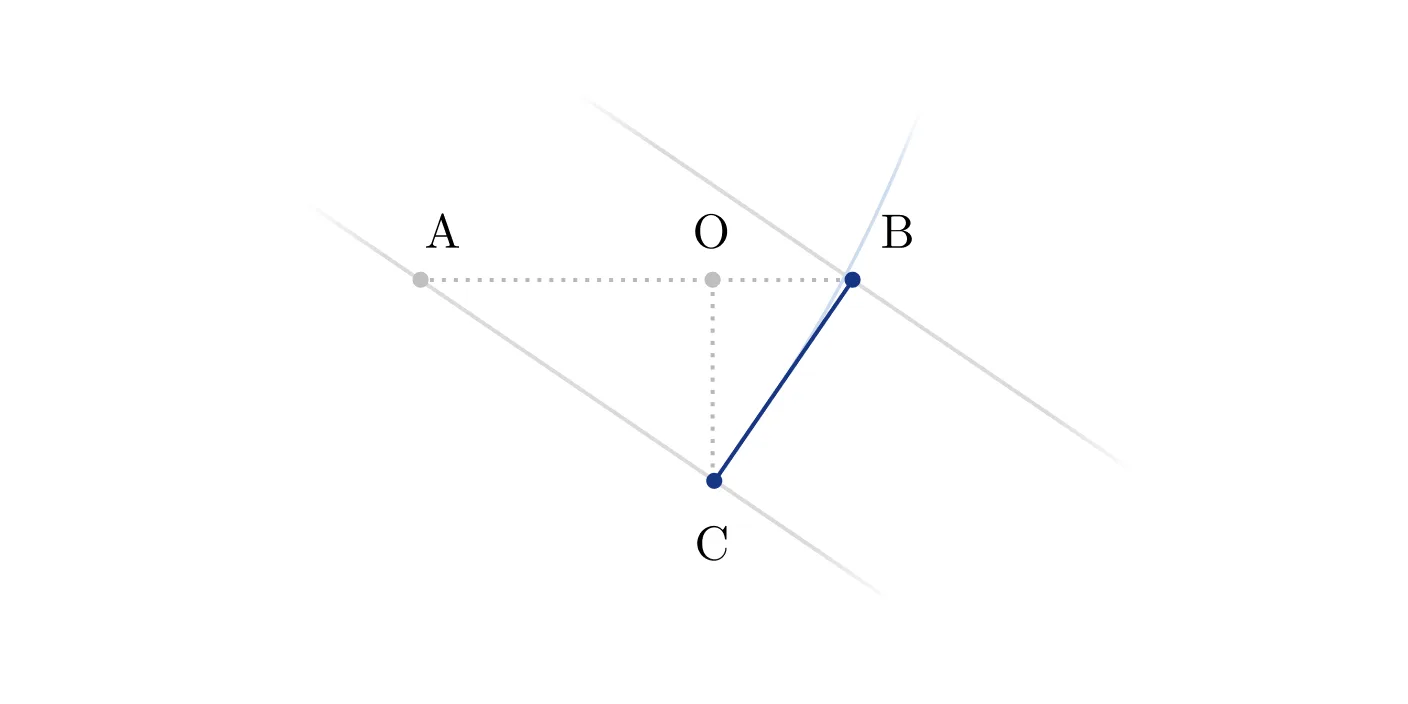
Solving this exercise via force components is straightforward, leading to the answer Δxcos⁡30∘sin⁡30∘\Delta x \cos 30^\circ \sin 30^\circ. However, I struggled with solving it using the principle of virtual work.

The hardest part of this exercise was calculating how the weight moves when we displace the cart. For simplicity, I reflected the diagram horizontally, aligning the movement with the standard x-axis.

One important point is that we cannot simply multiply the displacement by tan⁡30∘\tan 30^\circ, as this does not account for the fact that the weight moves along a circular path due to the rope.

I arrived at the following diagram, and the solution became clear from its geometry. In this diagram, the card moves to the right and AB=ΔxAB = \Delta x.

We can approximate the path of the weight by a straight line, as the angle of the rope will be small. Thus, we obtain:

∠ACB=90∘  ⟹  AC=AB⋅cos⁡30∘=Δx⋅cos⁡30∘\angle ACB = 90^\circ \implies AC = AB \cdot \cos 30^\circ = \Delta x \cdot \cos 30^\circ

Finally, we arrive at the correct answer:

∠AOC=90∘  ⟹  OC=AC⋅sin⁡30∘=Δx⋅cos⁡30∘⋅sin⁡30∘\angle AOC = 90^\circ \implies OC = AC \cdot \sin 30^\circ = \Delta x \cdot \cos 30^\circ \cdot \sin 30^\circ

I would be interested in solving this analytically by equating the equation for a circle with that of the plane to find the coordinates of the point. Ultimately, for the principle of virtual work, we only need to determine δyδx\frac{\delta y}{\delta x}.

If anyone stumbles upon this post and finds such a solution, please feel free to send a copy to simon.uvarov@icloud.com\text{simon.uvarov}@\text{icloud.com}.

Dec 03, 2024 #physics

It’s been almost two months since I bought Feynman’s exercises. I didn’t expect physics to capture my attention this much. I’ve finished six chapters and created 200 new Mochi cards since then.

The exercises turned out to be the key to understanding. There were many times when I read a chapter, thought I understood it, but then found myself lost when trying to solve a practical problem. There must be a reason for this phenomenon. My guess is that it’s easy to confuse familiarity with understanding. Reading gives you the sense of the tools you can use, but it doesn’t teach you how to use them.

Doing exercises highlighted how much I’ve forgotten from mathematics. As a refresher, I skimmed through Lang’s Basic Mathematics. I started going through Spivak’s Calculus, which has even more exercises than the Feynman’s books.

This experience makes me wonder how it’s possible to cover everything in university. Sometimes I spend days thinking about a single problem. I don’t know if you can afford that when you have other subjects to study.

Nov 19, 2024 #physics

The easiest way to solve 2.19 (Plank Weight Trough)

A plank of weight W and length 3R\sqrt{3}R lies in a smooth circular trough of radius RR. At one end of the plank is a weight W/2W/2. Calculate the angle θ\theta at which the plank lies when it is in equilibrium.

There are already a few solutions at the Feynman’s Lectures website, but my solution is simpler.

Since the plank is in equilibrium, it must be at its lowest possible position. This means the center of mass of the plank lies directly below the center of the trough.

We can calculate the center of mass cc given the length of the plank L=3RL = \sqrt{3}R:

c=11.5W(WL2+WL2)=L1.5=3R1.5=2R3\begin{aligned} c &= \frac{1}{1.5W}\bigg(\frac{WL}{2} + \frac{WL}{2}\bigg)\\[12pt] &= \frac{L}{1.5} = \frac{\sqrt{3}R}{1.5} = \frac{2R}{\sqrt{3}} \end{aligned}

Since cc forms the hypotenuse from the left point of contact to the vertical line beneath the trough center, we have:

cos⁡θ=Rc=R32R=32\cos \theta = \frac{R}{c} = \frac{R\sqrt{3}}{2R} = \frac{\sqrt{3}}{2}

This gives θ=30∘\theta = 30^{\circ}

Oct 28, 2024 #physics

Solving 2.17 and 2.18 Using the Principle of Virtual Work

It is possible to solve 2.17 and 2.18 using torques, but since the chapter was about using the virtual work principle, let’s use it.

Let's consider the ladder from the exercise 2.18 (2.17 uses similar approach) rotating clockwise due to the reactive force of the wall.

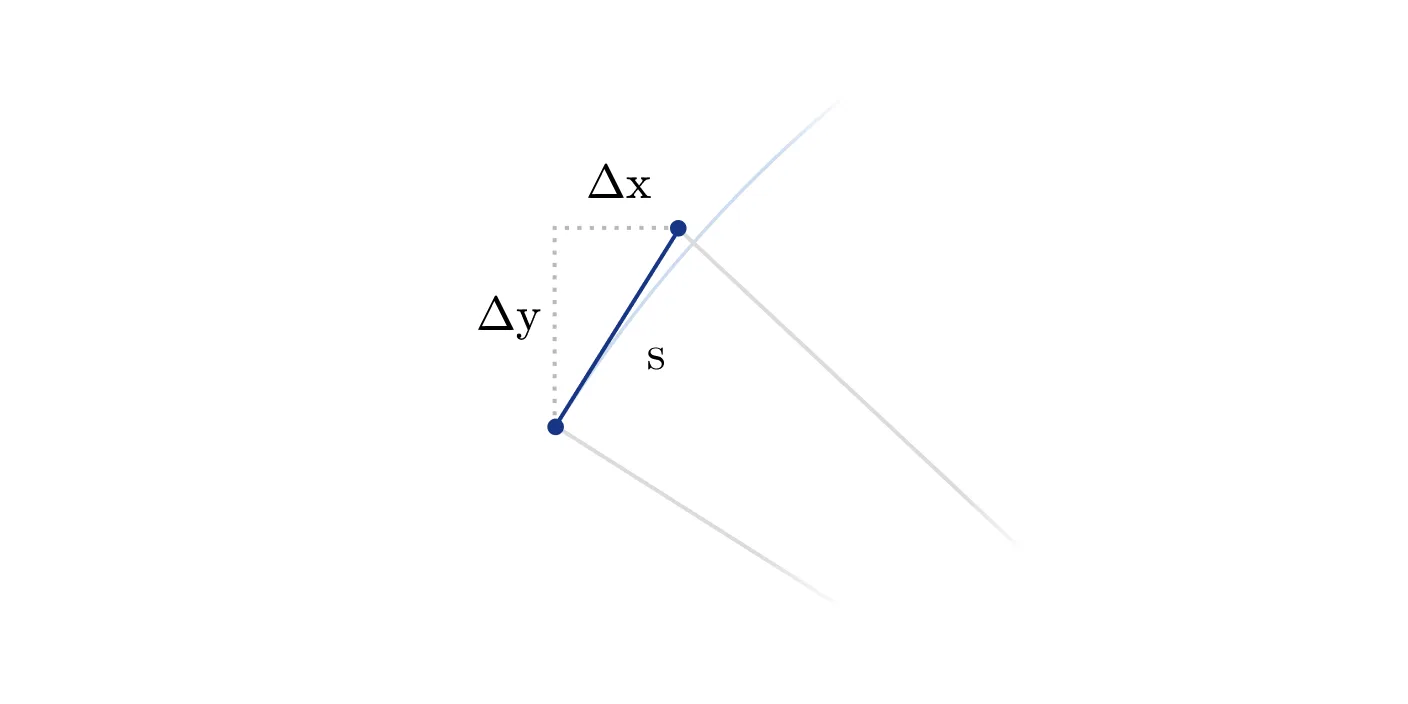
Let’s imagine a ladder rotating clockwise under the influence of the reaction force of the wall. As the ladder rotates by a small angle δθ\delta \theta radians, it displaces a distance s=δθ⋅rs = \delta \theta \cdot r (by the definition of a radian ).

For a small angle θ\theta, it is possible to approximate that any point on ladder moves in a straight line, not in a circular path (see figure below).

This linear movement allows us to compute displacement of each point on the ladder as the following:

Δx=ssin⁡θ=δθ⋅r⋅sin⁡θΔy=scos⁡θ=δθ⋅r⋅cos⁡θ\begin {aligned} \Delta x &= s \sin \theta = \delta \theta \cdot r \cdot \sin \theta \\ \Delta y & = s \cos \theta = \delta \theta \cdot r \cdot \cos \theta \end{aligned}

Now we can calculate the work done by a reactive force of the wall TT:

WT=T(δθ⋅L⋅sin⁡θ)W_T = T (\delta \theta \cdot L \cdot \sin \theta)

Changes in potential energies of the weight WW and the ladder ω\omega are:

EW=(δθ⋅0.75L⋅cos⁡θ)⋅WEω=(δθ⋅0.5L⋅cos⁡θ)⋅ω\begin{aligned} E_{W} &= (\delta \theta \cdot 0.75 L \cdot \cos \theta) \cdot W \\ E_{\omega} &= (\delta \theta \cdot 0.5 L \cdot \cos \theta) \cdot \omega \end{aligned}

Equating the work done by TT to the total change in potential energy yields:

T(δθ⋅L⋅sin⁡θ)=(δθ⋅0.5L⋅cos⁡θ)⋅ω+(δθ⋅0.75L⋅cos⁡θ)⋅W\begin{aligned} T (\delta \theta \cdot L \cdot \sin \theta) &= (\delta \theta \cdot 0.5 L \cdot \cos \theta) \cdot \omega \\ &\quad + (\delta \theta \cdot 0.75 L \cdot \cos \theta) \cdot W \end{aligned} T=ctg⁡θ(0.5ω+0.75W)T = \ctg{\theta} (0.5 \omega + 0.75 W)
Oct 26, 2024 #physics

Feynman’s Lectures Exercises 2.16

I spent more time on this exercise than needed because I didn’t notice that the masses are equal. Otherwise, the application of the virtual work principle is straightforward.

The work is done by the gravitation force and the force accelerates the entire system, that is M=m1+m2=2mM = m_1 + m_2 = 2m.

Let’s use the positive sign the direction of gravity acting on m2m_2.

The work can be calculate as:

W=FΔs=Ma⋅Δs=Ma⋅Δy2=2m⋅Δy2\begin{aligned} W &= F \Delta s \\ &= Ma \cdot \Delta s \\ &= Ma \cdot \Delta y_{2} \\ &= 2m \cdot \Delta y_{2} \end{aligned}

This work is equal to the change of the potential energy in the system as follows:

ΔEk=m2⋅g⋅Δy2−m1⋅g⋅Δy1=m⋅g⋅Δy2−m⋅g⋅Δy1=m⋅g⋅(Δy2−Δy1)=m⋅g⋅(Δy2−Δy2⋅sin⁡π4)\begin{aligned} \Delta E_k &= m_{2} \cdot g \cdot \Delta y_{2} - m_{1} \cdot g \cdot \Delta y_{1} \\ &= m \cdot g \cdot \Delta y_{2} - m \cdot g \cdot \Delta y_{1} \\ &= m \cdot g \cdot (\Delta y_{2} - \Delta y_{1}) \\ &= m \cdot g \cdot (\Delta y_{2} - \Delta y_2 \cdot \sin{\frac{\pi}{4}}) \end{aligned}

Thus, we get:

a=gm−m⋅sin⁡π42m=g(1−sin⁡π4)⋅m2m=g1−222=12(1−12)g\begin{aligned} a &= g \frac{m - m \cdot \sin{\frac{\pi}{4}}}{2m} \\[10pt] &= g \frac{(1 - \sin{\frac{\pi}{4}}) \cdot m}{2m} \\[10pt] &= g \frac{1 - \frac{\sqrt{2}}{2} }{2} \\[10pt] &= \frac{1}{2} (1 - \tfrac{1}{\sqrt{2}}) g \end{aligned}
Oct 25, 2024 #physics

Feynman’s Lectures Exercises 2.14 and 2.15

If the weights W1W_1 and W2W_2 move the distance ss along the plane to the left, their corresponding difference in height are:

Δh1=s⋅sin⁡θ,Δh2=−s⋅sin⁡θ\Delta h_1 = s \cdot \sin{\theta} , \quad \Delta h_2 = - s \cdot \sin{\theta}

Then, the difference in potential energy of the system is:

ΔEp=Δh1W1−Δh2W2\Delta E_p = \Delta h_1 W_1 - \Delta h_2 W_2

By the definition of work:

F⋅s=ΔEpF \cdot s = \Delta E_p

Then:

F=ΔEps=sin⁡θ⋅m1⋅g−sin⁡θ⋅m2⋅g=sin⁡θ⋅g⋅(m1−m2)\begin{aligned} F &= \frac{\Delta E_p}{s} \\[10pt] &= \sin{\theta} \cdot m_1 \cdot g - \sin{\theta} \cdot m_2 \cdot g \\[10pt] &= \sin{\theta} \cdot g \cdot (m_1 - m_2) \end{aligned}

For the acceleration along the plane, using a=Fma = \frac{F}{m} and the total mass m=m1+m2m = m_1 + m_2, the acceleration is:

a=sin⁡θ⋅g⋅m1−m2m1+m2a = \sin{\theta} \cdot g \cdot \frac{m_1 - m_2}{m_1+m_2}

For the motion over distance DD, starting from rest:

D=at22D = \frac{at^2}{2}

Thus:

t2=2Dat=2Da\begin{aligned} t^2 &= \frac{2D}{a} \\[10pt] t &= \sqrt{\frac{2D}{a}} \end{aligned}

The speed at time tt is given by:

v=at=a⋅2Da=2Da=2D⋅sin⁡θ⋅g⋅m1−m2m1+m2\begin{aligned} v &= at \\[0pt] &= a \cdot \sqrt{\frac{2D}{a}} \\[10pt] &= \sqrt{2Da} \\[2pt] &= \sqrt {2D \cdot \sin{\theta} \cdot g \cdot \frac{m_1 - m_2}{m_1 + m_2}} \end{aligned}

For Exercise 2.15, the acceleration is given by:

a=12⋅g⋅(sin⁡θ−sin⁡ϕ)a = \frac{1}{2} \cdot g \cdot (\sin{\theta} - \sin{\phi})

Substituting this into the expression for speed, we get:

v=g⋅D⋅(sin⁡θ−sin⁡ϕ)v = \sqrt{g \cdot D \cdot (\sin{\theta} - \sin{\phi})}
Oct 17, 2024 #physics

I finally bought the Feynman Lectures on Physics, something I wanted to do for a very long time. Ever since reading You're Surely Joking Mr. Feynman. After watching some of his interviews on YouTube and going through a few chapters online, I realized there's something special about how Feynman explains things. He doesn't just teach formulas — he teaches understanding. Once you grasp that, you realize what true understanding is. Here are a few quotes from the introduction to the New Millennium edition:

It was like going to church. The lectures were a transformational experience, the experience of a lifetime, probably the most important thing I got from Caltech. I was a biology major but Feynman’s lectures stand out as a high point in my undergraduate experience … though I must admit I couldn’t do the homework at the time and I hardly turned any of it in. I was among the least promising of students in this course, and I never missed a lecture. … I remember and can still feel Feynman’s joy of discovery. … His lectures had an … emotional impact that was probably lost in the printed Lectures.

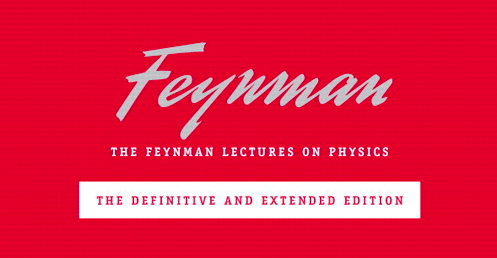
The book is beautiful. I don't choose books solely on looks, but when there are different options, it's better to go for the one you like. I’ve noticed that this works for anything — if I like something that’s part of an activity, I’m more likely to engage with it. So, in that sense, it is rational to choose a book by its cover. One sad thing is the lettering from the original edition has been lost in the New Millennium version:

Lettering from the original title has been lost in the New Millennium edition

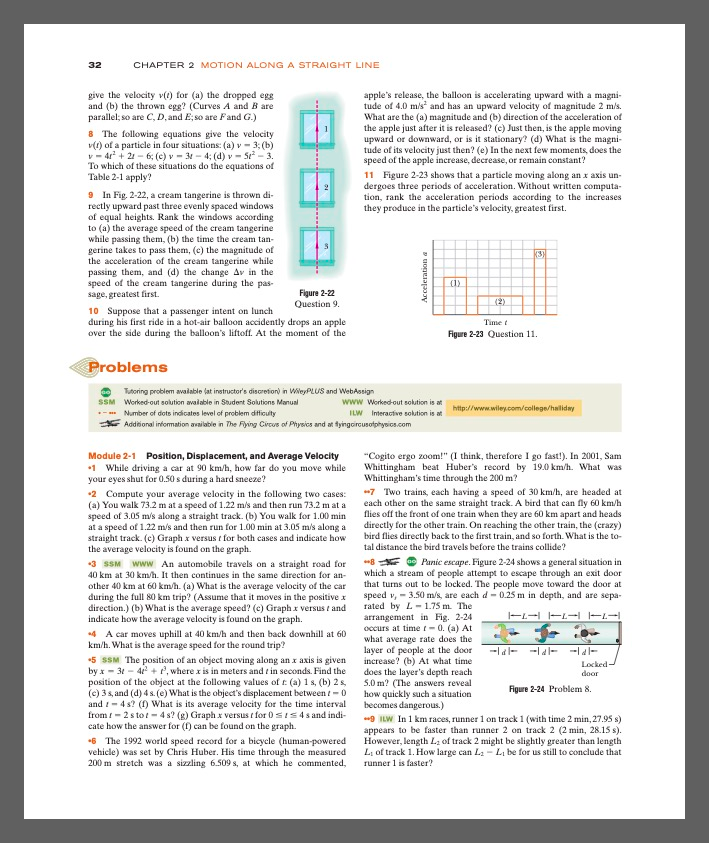
Almost all other popular physics books look very average. Compare another popular textbook with the austere design of Feynman’s lectures:

A page from another textbook on physics

My plan is to work through all three volumes over the winter and solve all the exercises from the companion workbook. I will buy a refresher for math once I hit a wall. There are a few books I have in mind: Spivak’s Calculus and The Princeton Companion to Applied Mathematics. Both are as beautifully designed as Feynman’s lectures.

Oct 16, 2024 #honest objects#physics